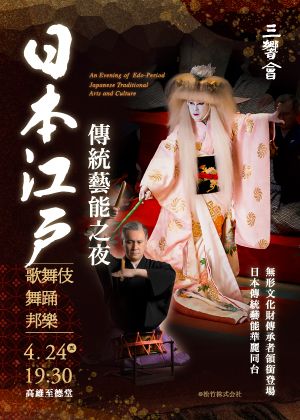
節目介紹
【田中傳次郎導演、歌舞伎演員大谷廣松老師的話】
【宣傳影片】
★2026高雄春天藝術節重磅國際節目㇐〈日本江戶傳統藝能之夜〉
★一夜穿越江戶時代—歌舞伎、舞踊、邦樂交織呈現日本傳統藝能盛宴
★重要無形文化財傳承者領銜演繹極致之美
「藝能是歷經時間淬煉,傳承於血脈中的文化記憶。」
高雄春天藝術節在2026年迎來第17屆。今年的亮點節目《日本江戶傳統藝能之夜》中,邀請來日本傳統音樂代表性的藝能名門——由三兄弟所組成的「三響會」一員,同時也是重要無形文化財傳承者—田中傳次郎老師親自為KSAF策劃,並且執導、演出,帶領觀眾走入日本傳統藝能的精神核心,一窺跨越世代、脈脈相傳的文化樣貌。演出架構以江戶時代所確立的傳統藝能為主軸。江戶時期不僅是日本舞台藝術形式之美集大成的時期,同時也是建立起以「傳承」為骨幹的藝能制度之時代。技藝不再為個人所有,而是代代相傳、必須不斷琢磨昇華的文化責任。正因為如此,無形文化財所重視的不僅只是技法本身,還包括背後傳承的精神和文化記憶。
“Traditional performing arts are cultural memories refined by time and passed down through bloodlines.”
The Kaohsiung Spring Arts Festival welcomes its 17th edition in 2026. One of this year’s highlight programs, An Evening of Edo-Period Japanese Traditional Arts and Culture, features one of Japan’s most distinguished traditional music lineages—Sankyokai, an ensemble formed by three brothers. The program is curated, directed, and performed specifically for KSAF by Tanaka Denjiro, a bearer of an Important Intangible Cultural Property. Through his artistic vision, audiences are guided into the spiritual core of Japanese traditional performing arts, offering a rare glimpse into a cultural legacy that has been passed down through generations.
The structure of the performance centers on traditional performing arts established during the Edo period. This era not only marked the culmination of aesthetic refinement in Japanese stage arts, but also the formation of an artistic system grounded in the principle of transmission. Artistic mastery ceased to belong to the individual alone; instead, it became a cultural responsibility—one that must be continuously refined, elevated, and entrusted to succeeding generations. For this reason, Important Intangible Cultural Properties preserve not only techniques themselves, but also the spirit, values, and cultural memory that underpin their transmission.
「我們應該悉心守護跨越世代傳承的藝能家和以其〈知・動・音〉。」
本公演匯聚日本武道、邦樂與傳統舞踊的精髓,從市瀨秀和的 《武道・居合道》出發,以身刀合一的演武,呈現日本武道對生死、美與心志的深層思想;和太鼓奏者辻勝、音間大誠與津輕三味線名家佐佐木光儀流二代家元共演《和太鼓組曲》 ,在層層迴響的節奏中,展現日本傳統邦樂與地域、儀禮及身體節奏交織的歷史脈絡。演出亦包含源自能樂儀式、象徵祈念與重生的《三番叟》 ,將由田中傳次郎與長男龜井太一於台灣首度父子同台共演演奏,體現世代傳承的使命;並由傳承稀少「歌舞伎囃子方」技藝的田中傳次郎演奏《船弁慶》,以多層次音樂推動情感與戲劇張力。歌舞伎名門出身的大谷廣松則帶來舞踊《島之千歳》,以踏步為節奏、身體配合樂器,與鼓聲精準呼應,展現「身體、音聲、空間」合而為一的傳統美學。本公演並特別呈現歌舞伎隈取化妝與著裝,讓觀眾近距離體驗登台前的準備儀式。最後,壓軸登場的《石橋》將以歌舞伎獨有的舞踊與音樂共演出磅礡能量,層層堆疊情緒,將現場氣氛一舉推向最高峰。
“We are entrusted with the careful preservation of the knowledge, movement, and sound carried by artists whose traditions span generations.”
This performance brings together the essence of Japanese martial arts, traditional music, and classical dance. It opens with Martial Arts: Iaido by Ichinose Hidekazu, whose disciplined demonstration of unity between body and sword embodies the profound Japanese philosophies of life and death, beauty, and inner resolve.
The program continues with the Taiko Suite, performed by taiko drummers Tsuji Masaru and Otoma Taisei, together with Sasaki Mitsuyoshi, second-generation grand master of the Tsugaru shamisen school. Through layered, resonant rhythms, the piece reveals the historical interweaving of Japanese traditional music with regional identity, ritual practice, and embodied rhythm.
Also featured is Sanbasō, a work originating from Noh ritual traditions and symbolizing prayer and renewal. This performance marks the first father-and-son appearance in Taiwan by Tanaka Denjiro and his eldest son Kamei Taichi, powerfully expressing the mission and responsibility of artistic transmission across generations. Tanaka Denjiro—one of the few remaining masters of Kabuki hayashi (musical accompaniment)—also performs Funabenkei, in which multilayered music drives emotional depth and dramatic tension, demonstrating the central role of kabuki music in theatrical expression.
Kabuki artist Ōtani Hiromatsu, born into a distinguished kabuki family, presents the dance Shima no Senzai, where rhythm is shaped through footwork and the dancer’s body becomes an instrument itself. In precise dialogue with the drum accompaniment, the performance reveals a traditional aesthetic in which body, sound, and space merge as one.
The program further includes a special presentation of kabuki kumadori makeup and costume dressing, offering audiences a rare, close-up view of the sacred preparations undertaken before stepping onto the stage. The evening concludes with a grand finale of kabuki dance, in which music drives the atmosphere to its climactic peak.
【企劃與導演介紹】 About the Creator
導演・演出 | 田中 傳次郎
歌舞伎囃子方。1977年出生。師事父母,並拜已故人間國寶八世觀世銕之丞為師。3歲時以能樂《田村》的謠曲,踏上能樂初舞臺。14歲於歌舞伎座出演《京鹿子娘道成寺》。17歲時襲名為「七世 田中 傳次郎」。18歲起擔任市川猿翁(第三代 猿之助)的專屬囃子,參與製作超級歌舞伎與復活歌舞伎的作調。多次參與美國、英國、義大利、荷蘭等海外歌舞伎公演。 目前亦以市川團十郎主演的舞臺為中心,活躍於眾多歌舞伎演出。20歲時,與兄長龜井廣忠、田中傳左衛門共同創立「三響會」。此後除參與多項公演的製作與企劃外,亦在製作活動的演出策劃方面獲得高度評價。2014與2015年於新加坡濱海灣金沙,2016 年於紐約卡內基音樂廳,製作並策劃「Japan Theater」。2019 年於天皇即位典禮相關、由內閣總理大臣伉儷主辦的晚宴文化活動中,出演狂言、歌舞伎、文樂《三番叟》。
2021 年,參與第 32 屆夏季奧林匹克運動會東京大會開幕式。2023年於英國牛津大學製作並策劃「坂東玉三郎 服裝展」;並於2025年於紐約卡內基音樂廳,策劃「An Evening of Traditional Japanese Arts」,深受讚譽,座無虛席,並獲得全場起立掌聲。長年於國立劇場養成所擔任講師,致力於後進人才的培育。 重要無形文化財綜合指定保持者。
Director & Performer | Tanaka Denjiro
A Kabuki hayashi (musical accompaniment) musician, born in 1977. He began his training under the guidance of his parents and later apprenticed to the late Living National Treasure Kanze Tetsunojō VIII. At the age of three, he made his Noh debut by chanting Tamura, marking his first appearance on the Noh stage. At fourteen, he performed Kyōganoko Musume Dōjōji at the Kabuki-za Theatre. At seventeen, he succeeded to the name Tanaka Denjiro VII.
From the age of eighteen, he served as the exclusive hayashi musician for Ichikawa Ennosuke III, contributing to the musical composition of Super Kabuki and revival kabuki productions. He has participated extensively in overseas kabuki performances in the United States, the United Kingdom, Italy, and the Netherlands, and remains highly active in major kabuki productions, particularly those starring Ichikawa Danjūrō.
At the age of twenty, he co-founded Sankyokai with his elder brother Hirotada Kamei and Denzaemon Tanaka. Since then, in addition to performing, he has received high acclaim for his work in program conception, production, and artistic planning.
He curated and produced Japan Theater at Marina Bay Sands, Singapore (2014 and 2015), and at Carnegie Hall, New York (2016). In 2019, he performed Sanbasō—encompassing Kyōgen, Kabuki, and Bunraku—at a cultural event held in conjunction with the Imperial Enthronement Ceremony, hosted by the Prime Minister of Japan and spouse.
In 2021, he participated in the Opening Ceremony of the 32nd Summer Olympic Games (Tokyo 2020). In 2023, he curated and produced the Bandō Tamasaburō Costume Exhibition at the University of Oxford. In 2025, he planned and presented An Evening of Traditional Japanese Arts at Carnegie Hall, New York, receiving outstanding critical acclaim, a sold-out audience, and a standing ovation.
He has long served as an instructor at the National Theatre Training Institute, dedicating himself to the cultivation of future generations of artists. He is a Designated Holder of an Important Intangible Cultural Property.
企劃‧製作團隊 | 三響會
由龜井廣忠、田中傳左衛門、田中傳次郎三兄弟,於1997年成立。三人出生並成長於藝術世家,父親為能樂葛野流大鼓方的人間國寶──龜井忠雄,母親則為歌舞伎囃子田中流前家元──第九代田中佐太郎。三兄弟以囃子為媒介,在尊重能樂與歌舞伎各自傳統的基礎上,持續探索嶄新的種種可能。
兄弟三人自幼便自由探索於「能樂」與「歌舞伎」這兩種相隔兩百年的傳統藝術之間。隨著歲月推移,長兄投身能樂,次兄與么弟則專注於歌舞伎,各自在不同的世界中潛心修行。然而,修行愈深,愈開始思考:「是否能在不破壞兩種藝術領域既有規範的前提下、自由往返其間,創造出唯有三響會才能呈現的演出形式。」因此,作為創造這一可能性的舞臺,三兄弟決定舉辦此會,並希望珍視由廣忠的大鼓、傳左衛門的小鼓、傳次郎的太鼓這三種樂器,以及三人傾注的氣魄所產生的「共鳴」。基於此理念,將本會命名為「三響會」。今後亦將透過融合等多樣演出形式,持續探索並創造傳統藝能的趣味與魅力。
Program Concept & Production Team | Sankyokai
Sankyokai was founded in 1997 by three brothers—Hirotada Kamei, Denzaemon Tanaka, and Denjiro Tanaka. Born and raised in a distinguished artistic family, their father was Tadao Kamei, a Living National Treasure and master drummer of the Kadono School of Noh hayashi (ōtsuzumi), while their mother was Satarō Tanaka IX, former head of the Tanaka School of Kabuki hayashi. Using hayashi—traditional musical accompaniment—as their medium, the three brothers continue to explore new artistic possibilities while maintaining deep respect for the individual traditions of Noh and Kabuki.
From an early age, the brothers freely traversed the worlds of Noh and Kabuki, two classical art forms separated by nearly two centuries in their historical development. As they matured, the eldest brother devoted himself to Noh, while the middle and youngest brothers pursued Kabuki, each undergoing rigorous training within their respective disciplines. Over time, a shared question emerged: Could they move freely between these two traditions—without violating their established forms—and create a mode of performance that only Sankyokai could realize?
To give shape to this vision, the brothers established Sankyokai as a platform for creation. They sought to cherish the resonance born from their three instruments—Hirotada’s ōtsuzumi, Denzaemon’s kotsuzumi, and Denjiro’s taiko—as well as from the spirit and intensity each performer brings to the stage. From this guiding principle came the name “Sankyokai” (Three Resonances).
Moving forward, Sankyokai continues to explore and reimagine the appeal and vitality of traditional performing arts through diverse forms of collaboration and fusion, opening new pathways for classical expression while remaining firmly rooted in tradition.

【節目內容】
一、 開場演出:武道 居合道
○ 市瀨 秀和
二、 《和太鼓組曲》
○ 辻勝、音間 大誠、佐佐木光儀
三、 音樂演奏《三番叟》
○ 田中 傳次郎、龜井 太一 等
四、 一調一管《船弁慶》
○ 田中 傳次郎 等
五、 舞踊《島之千歲》
○ 大谷 廣松、田中 傳次郎 等
六、 特別演出:歌舞伎隈取化妝與著裝
○ 大谷 廣松
七、 歌舞伎舞踊《石橋》
○ 大谷 廣松、田中 傳次郎 等
【演職人員名】Credits
導 演 |田中 傳次郎 Tanaka Denjiro
歌舞伎演員|大谷 廣松 Otani Hiromatsu
長唄・唄方|杵屋 勝英治 Kineya Katsueiji
長唄・唄方|杵屋 五太郎 Kineya Gotaro
長唄・三味線方|杵屋 勝國悠 Kineya Katsukuniharu
長唄・三味線方|松永 忠三郎 Matsunaga Chuzaburo
囃 子|田中 傳次郎 Tanaka Denjiro
囃 子|龜井 太一 Kamei Taichi
囃 子|藤舍 悅芳 Tosha Etsuho
囃 子|梅屋 陸人 Umeya Rikuto
囃 子|藤舍 傳生 Tosha Densho
後 見|市川 右若 Ichikawa Ujaku
和 太 鼓|辻 勝 Tsuji Masaru
和 太 鼓|音間 大誠 Otoma Taisei
津輕三味線|佐佐木 光儀 Sasaki Mitsuyoshi
殺 陣|市瀬 秀和 Ichinose Hidekazu
企劃・製作|三響會 Sankyokai
🌸#演前須知🌸
⟣ 本場次開放入場時間為18時50分。
⟣ 為維護演出品質及觀眾權益,請提前抵達劇場並準時入座。
⟣ 遲到觀眾請配合現場工作人員指示,於指定時機進場。
⟣ 現場販售限量節目冊,每本新臺幣100元整,僅收現金。
⟣ 請共同遵守劇場觀賞禮儀,以維護良好觀賞秩序。
⟣ 演出期間嚴禁攝影、錄影及錄音。
⟣ 演出進行中,請將行動電話及各類電子設備關機或調整為靜音模式。
⟣ 本場演出全長約120分鐘(含中場休息),實際時間以現場為準。請預留充裕時間,並留意末班交通資訊,以免影響返程。
⟣ 場館內禁止飲食,敬請配合現場工作人員之指引。
ღ最後,希望各位好好享受這一晚充滿日本江戶魅力的演出ღ
━━━━━ #觀賞提醒 ━━━━━
✧觀賞期間,請將注意力放在表演者的聲音、肢體與整體舞台呈現,細細感受演出的魅力。
✧為維持劇場的觀賞品質,敬請觀眾保持安靜,一同營造良好的觀演環境。
━━━━━ #節目亮點 ━━━━━
歌舞伎・舞踊・邦樂,帶你穿越江戶時代 🎌
✧ 無形文化財傳承者,親自領銜演出
✧ #田中傳次郎 與其長子首次海外同台共奏
✧ 歌舞伎舞踊與音樂、居合道演武、太鼓、三味線
✧ 特別演出:歌舞伎「隈取化妝&著裝」
※演前導聆
講者 | 林于竝 / 國立台北藝術大學戲劇學系副教授
時間 | 4/24(五) 19:00-19:20 高雄至德堂廳內
感謝|公益財團法人日本台灣交流協會高雄事務所
◎主辦單位保有節目異動權與解釋權。
The organizer reserves the right to make changes to the program and to interpret it.
折扣方案
晚鳥4張75折套票
即日起凡同時購買同場次四張票券享”75折”優惠(最低票價無折扣,套票退票請整套辦理).
敬老票5折
65歲(含)以上之長者購票享”5折”優惠(限本人,須於入場時提供有效證件供驗證)
愛心票及陪同者一人享5折:
持身心障礙證明購票享”5折”優惠,請於演出現場出示身障證明(陪同者需同時進場)
文化幣專屬青年席位5折自由座
需使用文化幣購票,使用100點(含)以上文化幣折抵,且於OPENTIX網站或APP購票可選任一票價享”5折”優惠,數量有限,售完為止。
限 *文化幣領用年齡對象*使用,入場時須出示身分證或健保卡等有效證件,並配合場館方查驗。
學生票8折
學生購票享”8折”優惠,請於演出現場出示”有效效期學生證”,國小(含)以下請攜帶健保卡驗證(最低票價無折扣)
聯邦卡友9折
凡持聯邦銀行信用卡於OPENTIX官網及實體票點購票享”9折”優惠(最低票價無折扣)
愛樂之友單張8折
愛樂之友購票享”8折”優惠,請於愛樂之友網站申請完成啟用後使用(最低票價無折扣)
加入高雄愛樂之友 https://www.otmember.life/kpcafkpcaf/
愛樂之友一起GO! 75折
愛樂之友購買同場次票券2張(含)以上享”75折”優惠,請於愛樂之友網站申請完成啟用後使用(最低票價無折扣)
上述優惠請擇一選用,各項優惠恕不併行。
入場不分年齡,一人一票憑票入場,入場請依票種規定驗證。
※青年席位票券僅限文化幣持有者”本人”使用,並請憑證件(身分證或健保卡)入場【本節目適用文化幣青年席位五折自由座優惠,提供之場次將顯示專屬折扣方案】
青年席位五折自由座僅限於OPENTIX網站與App使用100點以上文化幣支付,席次有限,售完為止。
※ 持青年席位票券者,須為符合當年度文化幣發放資格,並於入場時出示持票者之有效身分證件(身分證或健保卡),如無法出示相符證件之觀眾,當天現場不開放入場、亦不進行退/換票。
退票期限:
最遲須在演出日10日前(不含演出日)辦理,逾期無法受理。
例:演出日為6/29,最後退票期限為6/19。
退票手續費:
每張退票收取票面售價10%手續費。換票視同退票,需退票後重新購買。
申請方式:
【選擇電子票或尚未取紙本票】
- 以「信用卡、行動支付、文化幣全額支付」購票:
請使用OPENTIX線上退訂單功能,至會員>訂單紀錄>點入要退訂的訂單,按下「退訂單」勾選欲退項目,線上完成退訂。
※請留意,每日23:30-00:00為系統結算期間暫停服務。請務必留意退票期限,提前申請。
※購買團票、套票或其他無法使用退訂單功能時,請至網站勾選項目1,填寫訂單資料辦理。申請的退票如符合退票規則,將於3個工作日內執行退票作業。 以「ATM轉帳、現金」購票:
請至網站勾選項目2,填寫訂單資料並附上存摺照片辦理,申請的退票如符合退票規則,將於3個工作日內執行退票作業。
※ATM轉帳繳費時產生的轉帳手續費由銀行收取,如有退票情形(含換、補票及節目異動之退票),轉帳手續費恕無法一併退還。
【已取紙本票】
請由下述退票方案擇一辦理:
- 臨櫃退票:請於服務時間內,至OPENTIX臺北、臺中、臺南、高雄四大服務處辦理。
- 郵寄退票:請將存摺影本(刷卡購票無須提供)、票券、姓名電話等聯絡資訊於退票期限前(郵戳為憑),掛號郵寄至「100012臺北市中正區中山南路21-1號 OPENTIX 退票小組收」。退票郵寄前請記下票面之訂單編號,並請妥善保存掛號收據。
※郵寄退票之退票手續費發票將預設存入OPENTIX會員載具,如有其他需求,請郵寄後致電客服中心(02)3393-9888。
※以ATM轉帳或現金付款之票券,將在收到郵寄退票申請後,最遲10個工作日內轉帳至所提供之存摺帳戶;以刷卡付款之票券,退票款項將退還至原刷信用卡。
注意事項:
如購票時使用文化幣或點數折抵,退票時,系統將退還折抵之全額文化幣,並於扣除退票手續費後,優先退還點數,再將剩餘款項退回。特別提醒,退票時(含換、補票及因節目異動之退票),原訂單所抵用的點數、文化幣、優惠券已逾使用效期,恕無法補發或展延效期。(如優惠券發放之主辦單位另有規劃者,依該主辦單位規範辦理)。
【優惠組合退票】若購買兩個品項以上之優惠組合,退票須全數辦理退票,或退票後剩餘數量仍符合原優惠組合規則,方可辦理。
【套票退票】套票退票需整套辦理,無法以單張票券申請退票,亦不接受換票。如購買不同場次票券,最遲需於所購買的首場演出日10日前(不含演出日)辦理,如套票另有規定者,請依套票頁面之注意事項為主。
※ 依據文化部「藝文表演票券定型化契約應記載及不得記載事項」第3點規定,若本節目因故取消、延期舉行之主要表演人員或主要節目內容,於預定表演前發生變動時,相關退票機制、受理方式、退款途徑等資訊,將另行公告於本節目頁面;若遇上述異動情境,主辦單位未提供退款機制時,以信用卡購票之持卡人,可向原信用卡發卡行申請信用卡爭議款退款。