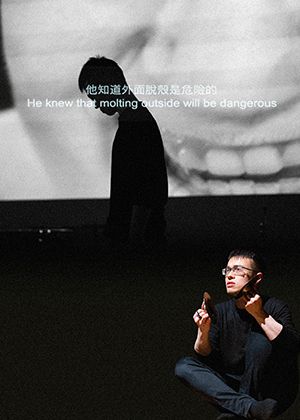
2026擊思藍盒子《房間裡的大象》
Percussion Meets Blue Box: Elephant in the Room
節目介紹
延伸閱讀▸ 狂人比較可怕?還是那些沉默的人?專訪《房間裡的大象》謝孟甫▸
▸ https://tpac.org.taipei/posts/561
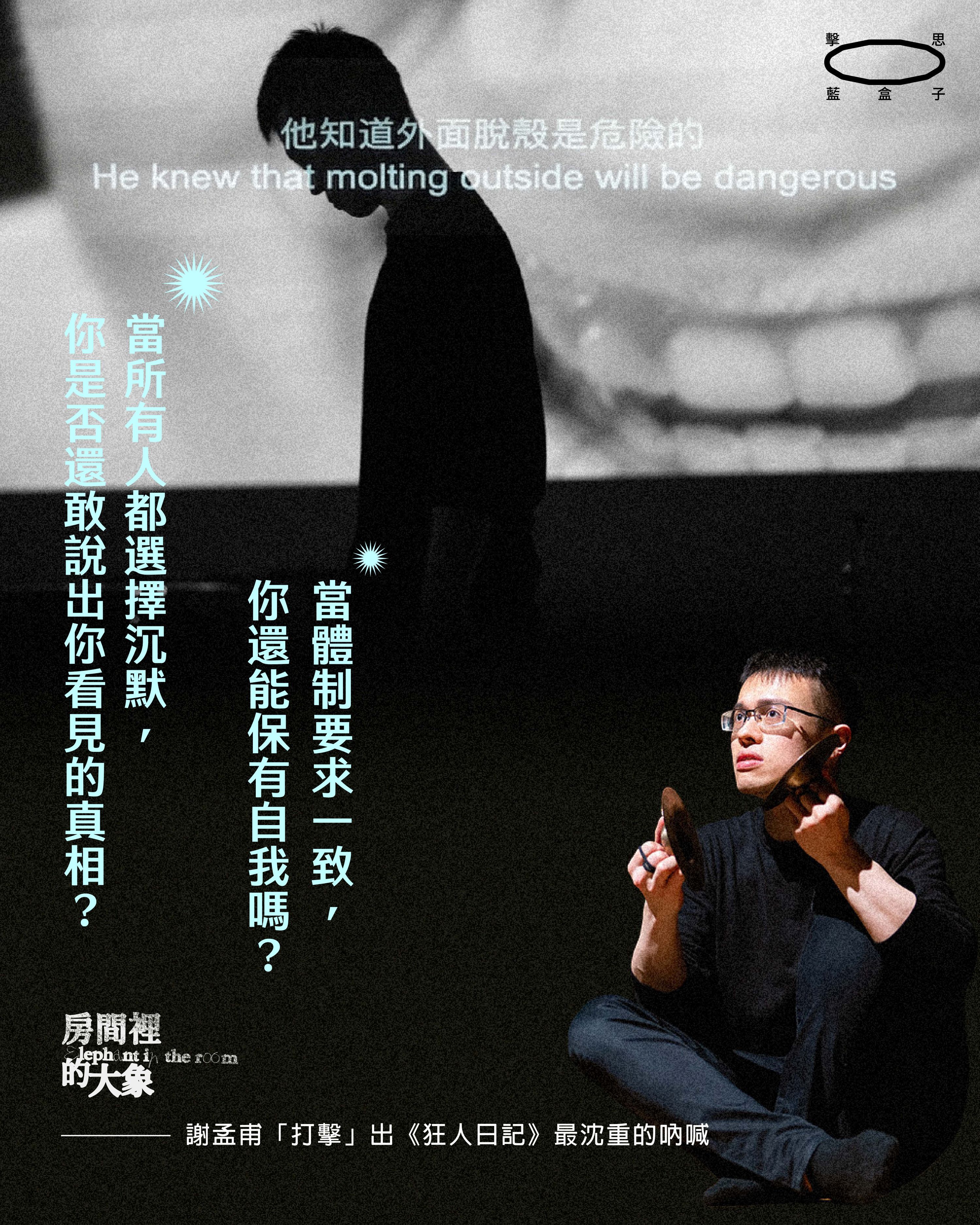
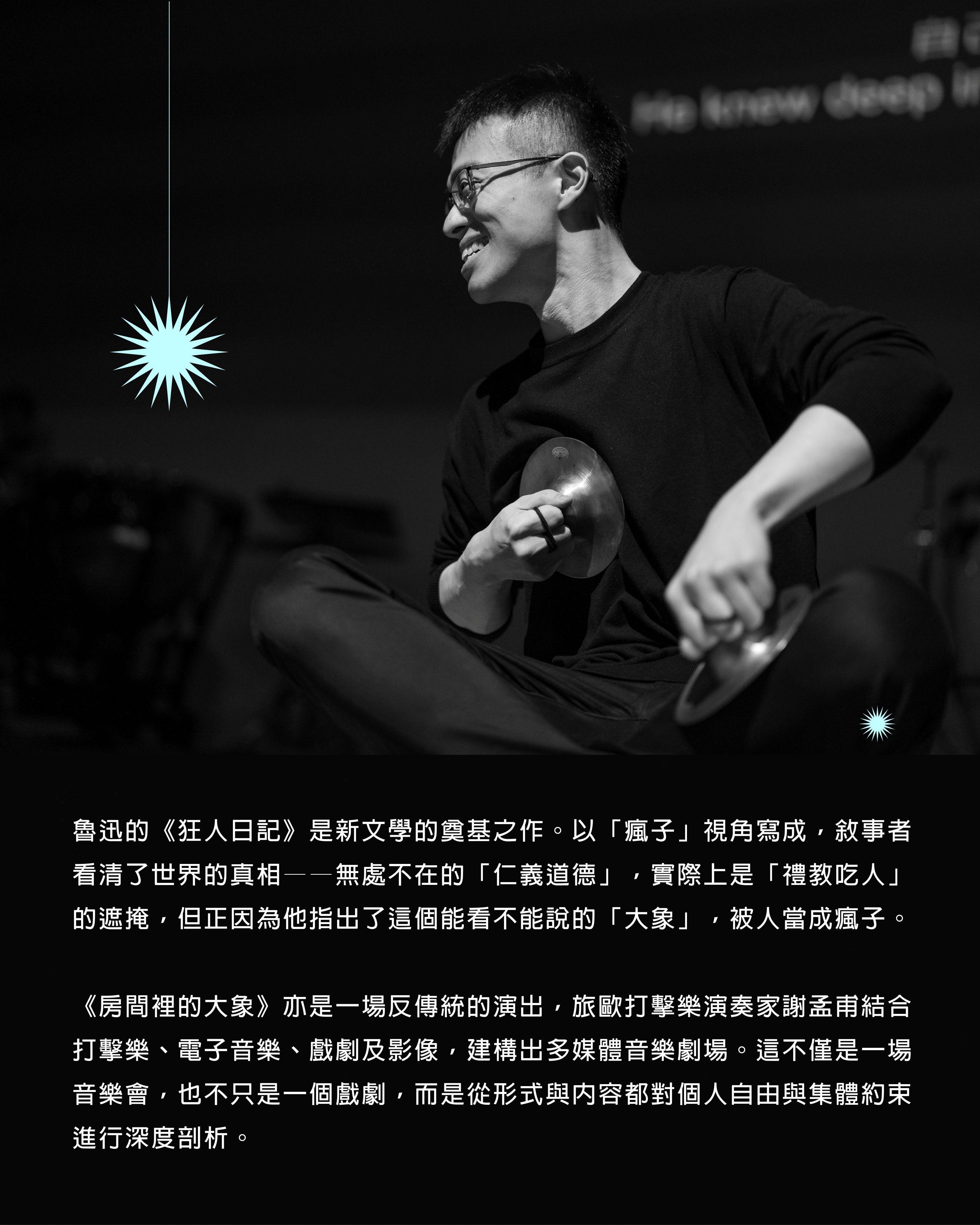
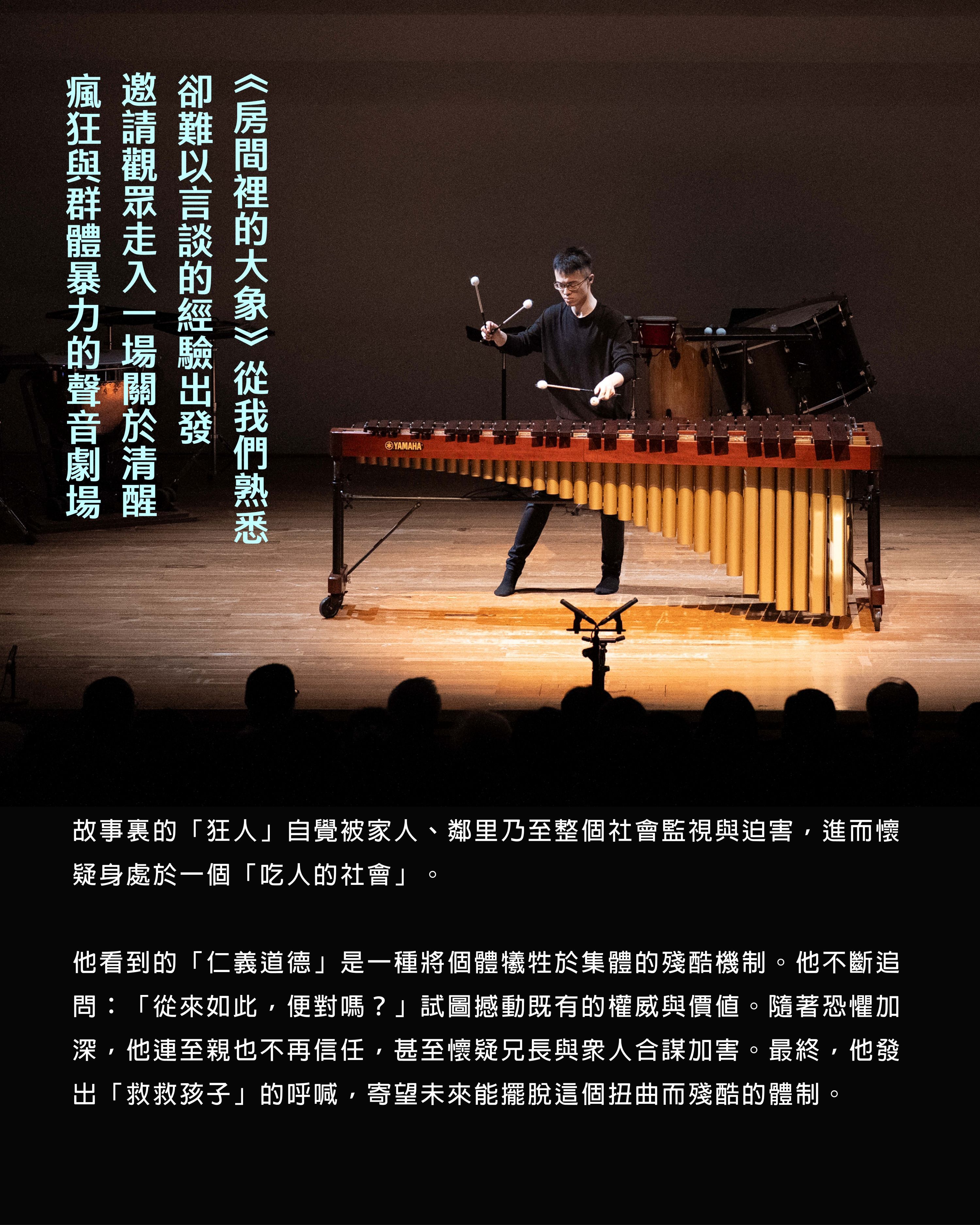
 (照片攝影:鄭博安)
【主創者介紹】
臺灣|謝孟甫 Meng-Fu Hsieh
改編劇本/音樂劇場主創/主演
謝孟甫,1995年出生於臺灣,為活躍於國際舞台的新生代打擊樂獨奏家與音樂劇場創作者,現為Yamaha Europe歐洲山葉音樂簽約藝術家(Yamaha Artist),為少數受邀加入此國際藝術家陣容之臺灣擊樂家之一。其藝術實踐橫跨當代擊樂獨奏、電子音樂、音樂劇場與跨域創作,擅長以聲音為敘事核心,將演奏者的身體、空間與戲劇結構整合為完整的舞台語言。
謝孟甫先後就讀於法國里昂國立高等音樂與舞蹈學院(CNSMD de Lyon)與德國斯圖加特音樂暨表演藝術大學(HMDK Stuttgart),師承Jean Geoffroy、Marta Klimasara等國際重量級擊樂家,並於2025年以最高榮譽取得德國Konzertexamen最高演奏文憑。其演出足跡遍及歐洲、亞洲與美國,曾受邀於荷蘭TROMP國際打擊樂大賽得獎者音樂會、美國PASIC國際打擊樂年會、俄羅斯莫斯科當代音樂節、斯圖加特世界木琴大賽、日本Keiko Abe國際音樂節等重要舞台演出,展現兼具精緻音色、現代擊樂語彙與強烈劇場能量的個人風格。
【演出暨製作人員名單】
改編/主演|謝孟甫
原創/作曲|滕晴晴
合作演出|李惠綺、郭育伶、邱品程
執行統籌|而安藝術文化 WhARTS
專案行政|謝家綺
舞臺監督|林頎姍
音場設計/現場混音|秝鴻盛有限公司 邵柯翰
影像設計|孫旻
燈光設計|呂沅澤
主辦單位|臺北表演藝術中心
總策畫|朱宗慶
製作單位|財團法人擊樂文教基金會
特別感謝|台灣山葉音樂股份有限公司、益響空間、豪聲樂器
When silence becomes the norm, dare you speak what you see?
When conformity is systematic, what remains of the true-self?
Percussionist Meng-Fu Hsieh strikes out the most harrowing cry in Diary of a Madman.
A cornerstone of modern Chinese literature, Lu Xun’s Diary of a Madman depicts stories told through the eyes of a lunatic. The narrator perceives a terrifying truth: the omnipresent rhetoric of Chinese morality—benevolence, righteousness, propriety—is nothing more than a veil for a cannibalistic social order. Yet precisely because he called out the “Elephant in the Room,” he is dismissed as insane. The multimedia music-theater work Elephant in the Room extends this act of defiance. Percussionist Meng-Fu Hsieh merges percussion, electronic music, theatre, and video into a multimedia music-theater work. Neither concert nor play, the piece interrogates the tension between individual freedom and collective constraint, both formally and conceptually.
Drawing on experiences we all recognize yet rarely articulate, Elephant in the Room invites audiences into a theater of auditory lucidity, madness, and collective violence.
In the story, the “madman” becomes increasingly convinced that he is being surveilled and persecuted by family, neighbors, and society at large. He comes to believe he lives within a “man-eating” world, where morality serves as a mechanism of sacrifice and subordinating the individual to the collective. He asks, again and again: “If it has always been so, does that make it right?” As fear deepens, even those closest to him become suspicious. In the end, he cries out: “Save the children,” a fragile hope that the future may escape this seemingly peaceful disorder.
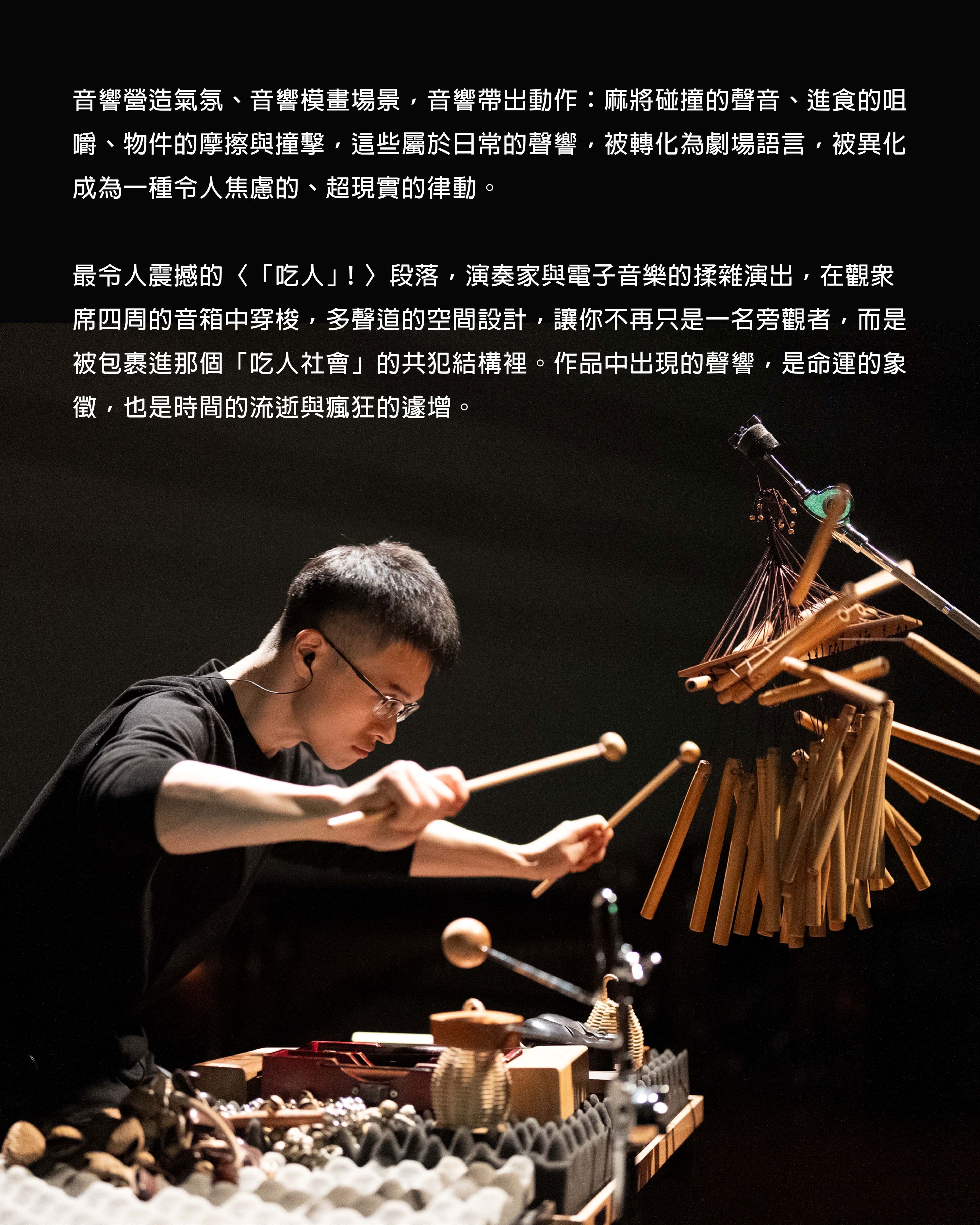
Sound constructs atmosphere. Sound sketches space. Sound propels action. The clatter of mahjong tiles, the act of chewing, the friction and collision of objects—these everyday noises are transformed into theatrical language, creating an anxious, surreal rhythm.
In its most unsettling passage, “Cannibalism!,” performers and electronic sound move through a multi-channel spatial design that surrounds the audience. No longer mere observers, the audience is enveloped—implicated within the very structure of this “man-eating society.” The sounds that emerge are at once markers of fate, of time passing, and of madness intensifying.
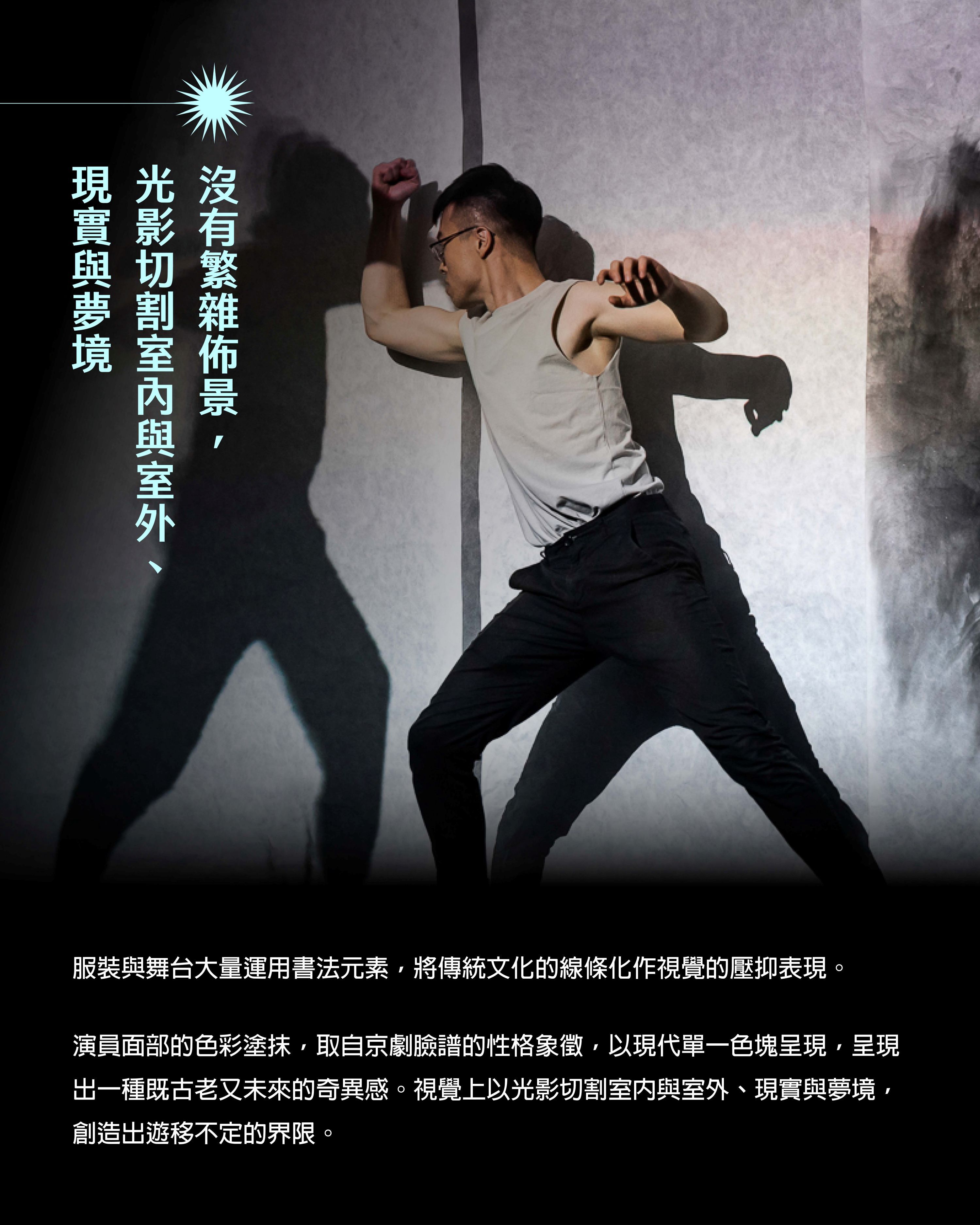
With no complicated stage design, light and shadow draw distinct boundaries between the interior and exterior, reality and dream.
The show’s costume and stage design draw heavily on calligraphic elements, translating the lines of tradition into visual pressure. Facial markings borrow from the symbolic codes of Peking opera, reinterpreted through stark, contemporary color fields, producing an uncanny fusion of the archaic and the futuristic. Visually, light and shadow carve up interior and exterior, reality and dream, creating boundaries that remain in constant flux.
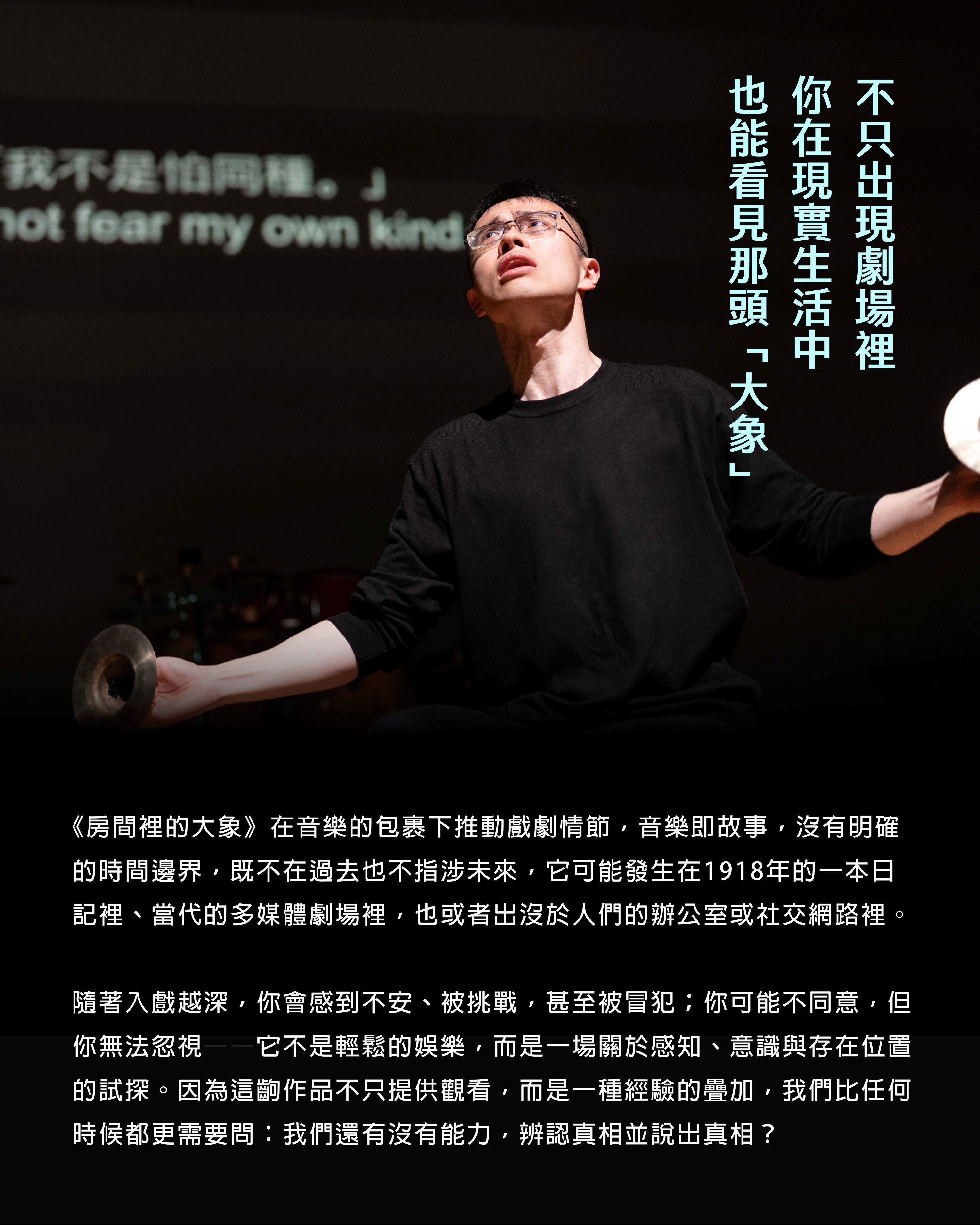
The “elephant in the room” does not sit still on the stage. It walks into your reality.
Propelled by music, where sound itself becomes narrative, the work exists outside a fixed timeframe. It may unfold in a diary from 1918, in a contemporary multimedia theater, or within the cubicle confines of work and into your social network.
As you are drawn in deeper, you may feel unsettled, challenged, or even provoked. You may disagree, but you may not disregard its existence. Elephant in the Room is not disposable entertainment, but an exploration of perception, consciousness, and one’s position within the world. Because this work offers not just something to watch, but something to experience, we are compelled—perhaps more than ever—to ask: Do we still possess the ability to recognize the truth—and to speak it?
Meng-Fu Hsieh
Adapted Script, Lead Music-Theatre Creator & Performer
Born in Taiwan in 1995, Meng-Fu Hsieh is an internationally active percussion soloist and music-theatre creator, and a Yamaha Europe Artist. His artistic practice bridges contemporary percussion, electronic music, and interdisciplinary theatre, focusing on sound as a narrative medium and the performer’s body as a dramaturgical presence. Trained at the Conservatoire National Supérieur de Musique et de Danse de Lyon and the University of Music and Performing Arts Stuttgart, he studied with Jean Geoffroy and Marta Klimasara., etc, and in 2025 graduated from the Konzertexamen program with highest distinction. His performance career has taken him to major international platforms including TROMP Percussion International Competition (Laureates’ Recital Series), PASIC, the Keiko Abe International Music Festival, the Moscow Forum for Contemporary Music, and the World Marimba Competition.
折扣方案
了解更多北藝會員:https://tpacplayer.org/DlYyH
2026.5.4 (一)中午 12:00 ── 5.11(一)11:59 付費會員預購
付費會員優惠:
北藝中心會員──成癮玩家不限張數75折,滿3場送1張5折券
北藝中心會員──團隊玩家4張以下85折、單場單筆訂單4張(含)以上8折、10張(含)以上75折
2026.5.11(一)中午12:00 正式啟售
會員優惠:
北藝中心會員──成癮玩家85折,滿3場送1張5折券
北藝中心會員──團隊玩家單張85折、單場單筆訂單4張(含)以上75折、10張(含)以上7折
北藝中心會員──新手玩家9折,北藝官網免費註冊享購票優惠
預約註冊85折優惠:
2026.4.6(一)00:00── 5.10(日)23:59
於指定期間內於北藝官網免費註冊「新手玩家」,享主辦節目88折優惠券2張。(使用期限為2026.6.7(日)前)
新手玩家套票優惠:
2026.5.11(一)中午 12:00 ── 6.7(日)23:59
購買700元(含)以上票券 ── 2張享88折,3張(含)以上享85折
異業優惠:
2026.5.11 (一) 中午 12:00 起
誠品會員、玉山銀行、台北富邦銀行、台新銀行、永豐銀行銀行卡友購票享優惠92折
團票優惠:
單場單筆訂單 20 張(含)以上 8 折
單場單筆訂單 50 張(含)以上 75 折
單場單筆訂單 100 張(含)以上 7 折
其他優惠:
身心障礙人士及其必要陪同者(限1人)享5折,入場時應出示身心障礙證明,陪同者與身障者需同時入場。
年滿65歲以上長者購票5折,入場時請出示有效證件。
※ 主辦單位保留節目異動權及折扣解釋權
退票期限:
最遲須在演出日1日前(不含演出日)辦理,逾期無法受理。
例:演出日為6/29,最後退票期限為6/28。
退票手續費:
每張退票收取票面售價10%手續費。換票視同退票,需退票後重新購買。
申請方式:
【選擇電子票或尚未取紙本票】
- 以「信用卡、行動支付、文化幣全額支付」購票:
請使用OPENTIX線上退訂單功能,至會員>訂單紀錄>點入要退訂的訂單,按下「退訂單」勾選欲退項目,線上完成退訂。
※請留意,每日23:30-00:00為系統結算期間暫停服務。請務必留意退票期限,提前申請。
※購買團票、套票或其他無法使用退訂單功能時,請至網站勾選項目1,填寫訂單資料辦理。申請的退票如符合退票規則,將於3個工作日內執行退票作業。 以「ATM轉帳、現金」購票:
請至網站勾選項目2,填寫訂單資料並附上存摺照片辦理,申請的退票如符合退票規則,將於3個工作日內執行退票作業。
※ATM轉帳繳費時產生的轉帳手續費由銀行收取,如有退票情形(含換、補票及節目異動之退票),轉帳手續費恕無法一併退還。
【已取紙本票】
請由下述退票方案擇一辦理:
- 臨櫃退票:請於服務時間內,至OPENTIX臺北、臺中、臺南、高雄四大服務處辦理。
- 郵寄退票:請將存摺影本(刷卡購票無須提供)、票券、姓名電話等聯絡資訊於退票期限前(郵戳為憑),掛號郵寄至「100012臺北市中正區中山南路21-1號 OPENTIX 退票小組收」。退票郵寄前請記下票面之訂單編號,並請妥善保存掛號收據。
※郵寄退票之退票手續費發票將預設存入OPENTIX會員載具,如有其他需求,請郵寄後致電客服中心(02)3393-9888。
※以ATM轉帳或現金付款之票券,將在收到郵寄退票申請後,最遲10個工作日內轉帳至所提供之存摺帳戶;以刷卡付款之票券,退票款項將退還至原刷信用卡。
注意事項:
如購票時使用文化幣或點數折抵,退票時,系統將退還折抵之全額文化幣,並於扣除退票手續費後,優先退還點數,再將剩餘款項退回。特別提醒,退票時(含換、補票及因節目異動之退票),原訂單所抵用的點數、文化幣、優惠券已逾使用效期,恕無法補發或展延效期。(如優惠券發放之主辦單位另有規劃者,依該主辦單位規範辦理)
【優惠組合退票】若購買兩個品項以上之優惠組合,退票須全數辦理退票,或退票後剩餘數量仍符合原優惠組合規則,方可辦理。
【套票退票】套票退票需整套辦理,無法以單張票券申請退票,亦不接受換票。如購買不同場次票券,最遲需於所購買的首場演出日1日前(不含演出日)辦理,如套票另有規定者,請依套票頁面之注意事項為主。
※ 依據文化部「藝文表演票券定型化契約應記載及不得記載事項」第3點規定,若本節目因故取消、延期舉行之主要表演人員或主要節目內容,於預定表演前發生變動時,相關退票機制、受理方式、退款途徑等資訊,將另行公告於本節目頁面;若遇上述異動情境,主辦單位未提供退款機制時,以信用卡購票之持卡人,可向原信用卡發卡行申請信用卡爭議款退款。