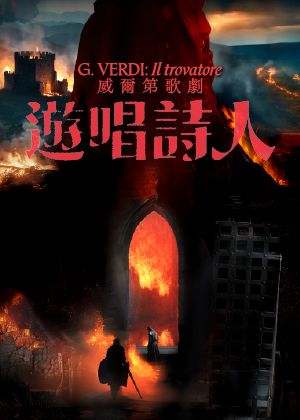
節目介紹
愈陰森就愈華麗,愈難唱也愈刺激:
令人血脈賁張的《遊唱詩人》
《遊唱詩人》和同時寫作的《茶花女》以及稍早的《弄臣》,是威爾第中期歌劇的頂冠三連作。「如果你去非洲深處,肯定也能聽到《遊唱詩人》。」作曲家的自信果真不假:它從彩排就轟動,聲樂曲譜很快就傳至世界各地,跨越時空一路熱演,至今仍是劇院寵兒。不只著名詠嘆調與二重唱膾炙人口,第二幕的鐵砧合唱更已成為流行文化,在影視作品、廣播廣告、甚至運動賽事裡頻繁出現,名列古典音樂最為人熟知的作品。
如此佳績並非僥倖。自第三部歌劇《納布果》揚名立萬之後,威爾第在九年內一口氣寫了十二部歌劇。巨大的寫作壓力雖然無法保證品質,至少為這位天賦勤奮皆備的作曲家積累了豐厚經驗。他知道如何從浪漫文學取材,不重複傳統義式歌劇的老路,段落編排也更多樣化。聲樂上,威爾第拓寬了男中音與次女高音的音域,高音更高、低音更低,要他們更強勢、更具威脅性也更富誘惑性,和男女高音拚搏較勁。即使角色情感表現直接,幾乎不外愛恨、家國、榮譽、夢境,普遍缺少獨立個性與發展,威爾第仍然以他深富衝勁與動感的音樂彌補了這個弱點,打造出令人熱血沸騰的聲樂饗宴。
《遊唱詩人》正是這樣的代表。它的劇情完全是浪漫主義的恐怖美學,開場就籠罩在不安夜色與邪門傳說,繼之而來的則是鬥毆、復仇、逼姦與死亡。歌劇敘事分散開展,遊唱詩人捲入手足冤孽,情愛糾葛血染女巫哀歌,觀眾必須全神貫注,方能從唱詞拼出故事全貌,解開折磨兩代、令人毛骨悚然的懸疑謎案。與之對應的則是豐富多變的舞台場景:鬧鬼宮殿、古堡要塞、幽暗地牢、吉普賽營火與修道院迴廊,被打斷的婚禮以及等著受害者的刑場,在在令人目眩神迷。雖然它不符合歷史,也沒有深刻的文學內涵,卻真正把音樂與浪漫主義合而為一,從頭到尾都刺激感官,又有誰會抱怨呢?
比視覺效果更驚奇的,自然是威爾第的音樂。聲樂家得使出渾身解數,還要超越極限,才有可能達到他的要求。女主角蕾歐諾拉要有最全面的美聲技巧,是歌劇舞台上最難唱好的絕頂角色,光是登場詠嘆調就是艱鉅考驗,之後更有諸多艱深獨唱與重唱。男主角曼里科本質是抒情詩人,經過義大利傳統催化,如今變成得具備衝擊性唱法的戲劇男高音,〈看那可怕的烈焰〉已是男高音的永恆惡夢。然而,「《遊唱詩人》要成功,你得找來四位偉大歌唱家。」傳奇巨匠卡羅素的評語一點沒錯,吉普賽女巫、曼里科的母親阿祖切娜,其實是另一位女主角,威爾第甚至考慮以她命名歌劇。這個角色以最華麗魅惑的唱段高歌最陰森駭人的咒怨,著實令人難忘。至於既壞又狠的魯納伯爵,是義大利歌劇裡最咄咄逼人的角色。看他發動所有攻勢,掀起音樂的驚滔駭浪,沒有人能不被打動。
面對經典,衛武營這次將與2024《瑪儂.雷斯考》導演與舞台設計再度合作,以《冰與火之歌:權力遊戲》的古裝意象,透過家族旗幟與烈火狂燄,打造視覺強烈的中世紀舞台,展現劇本與音樂獨特的陰暗美學。加上國內外頂尖音樂家齊聚一堂,絕對令人難忘。歡迎大家共襄盛舉,親自體會威爾第名作的不朽魅力,永恆的《遊唱詩人》!
(撰文/焦元溥)
The more sinister, the more magnificent; the harder to sing, the more thrilling: The Exhilarating Il trovatore
Il trovatore, along with La traviata (written concurrently) and the slightly earlier Rigoletto, forms the triumphant trio of VERDI's middle-period operas. The composer's confident prediction — "If you go to Africa, you will surely hear Il trovatore" — proved prophetic. A sensation from its very first rehearsal, the opera's vocal scores spread rapidly across the globe. It remains a theater staple, performed continuously across time and distance. Its famous arias and duets are widely beloved, and the "Anvil Chorus" from Act II has become a fixture in popular culture, appearing in films, television, radio advertisements, and even sporting events — cementing its place among the most recognizable works in the classical canon.
This success was no accident. After rising to fame with his third opera, Nabucco, VERDI wrote twelve operas in nine years. While such relentless output couldn't guarantee quality, it gave this gifted and disciplined composer an extraordinary wealth of experience. He mastered the art of drawing from Romantic literature, steering away from the well-worn paths of traditional Italian opera and broadening his structural palette. Vocally, VERDI pushed the baritone and mezzo-soprano to new extremes — higher highs and lower lows — demanding greater power, menace, and seduction, and setting them in dramatic rivalry against the tenor and soprano. Though his characters' emotions are broadly drawn, revolving around love, hatred, honor, loyalty, and longing, and rarely develop as individuals, VERDI more than compensated for the weakness with music of fierce energy and momentum, crafting a thrilling vocal spectacle.
Il trovatore is the perfect embodiment of this approach. Its plot is steeped in Romantic Gothic atmosphere: the opera opens in a night thick with unease and dark legend, then plunges headlong into brawls, vengeance, attempted assault, and death. The story unfolds in fragments — a troubadour caught in fraternal enmity, a love triangle shadowed by a witch's curse — and demands close attention from the audience, who must piece together from the libretto the full horror of a mystery spanning two generations. The stage settings are correspondingly rich and varied: a haunted palace, a fortified castle, a shadowy dungeon, a Gypsy campfire, a convent cloister, an interrupted wedding, and a scaffold awaiting its victims. All of it is utterly mesmerizing. Whatever it may lack in historical accuracy or literary depth, Il trovatore is a seamless fusion of music and Romanticism that electrifies the senses from first note to last — and who could ask for more than that?
Even more astonishing than the visual spectacle, of course, is VERDI's music. Soloists must summon every ounce of their skill and push themselves to the limit to meet his demands. The heroine Leonora calls for the most complete bel canto technique, making her one of the most challenging and rewarding roles in all of opera; her entrance aria alone is a formidable test, followed by a succession of difficult solos and ensembles. The hero Manrico is at heart a lyric poet who, by the imperatives of Italian dramatic tradition, must transform into a powerful dramatic tenor capable of visceral impact; his "Di quella pira" ("See that dreadful flame") remains the eternal nightmare of tenors. Yet as the legendary CARUSO rightly observed: "To succeed with Il trovatore, you need four great singers." The Gypsy sorceress Azucena — Manrico's mother — is effectively the opera's second female lead, a status VERDI himself acknowledged by considering naming the opera after her. She delivers the most sinister and chilling imprecations through the most magnificent and seductive vocal writing, making her utterly unforgettable. And as for the ruthless, implacable Count di Luna — the most ferocious baritone role in the Italian opera repertoire — watching him unleash his attacks and whip up a musical tempest leaves no one unmoved.
To take on this classic, National Kaohsiung Center for the Arts (Weiwuying) will once again collaborate with the stage director and set designer behind the 2024 production of Manon Lescaut. Drawing on the visual language of Game of Thrones, they will deploy family banners and roaring flames to conjure a visually striking medieval world, giving full expression to the libretto and score's distinctive dark aesthetics. With a cast of top-tier musicians from Taiwan and abroad, this production promises to be an experience like no other. We invite you to join us and discover for yourself the immortal power of VERDI's masterpiece — the eternal Il trovatore.
(Written by CHIAO Yuan-pu)
延伸閱讀

演出人員名單
指揮|簡文彬
導演|皮耶.弗朗切斯科.馬埃斯特里尼
舞台設計|尼古拉斯.博尼
影像設計|王奕盛
服裝設計|謝建國
燈光設計|黃羽菲
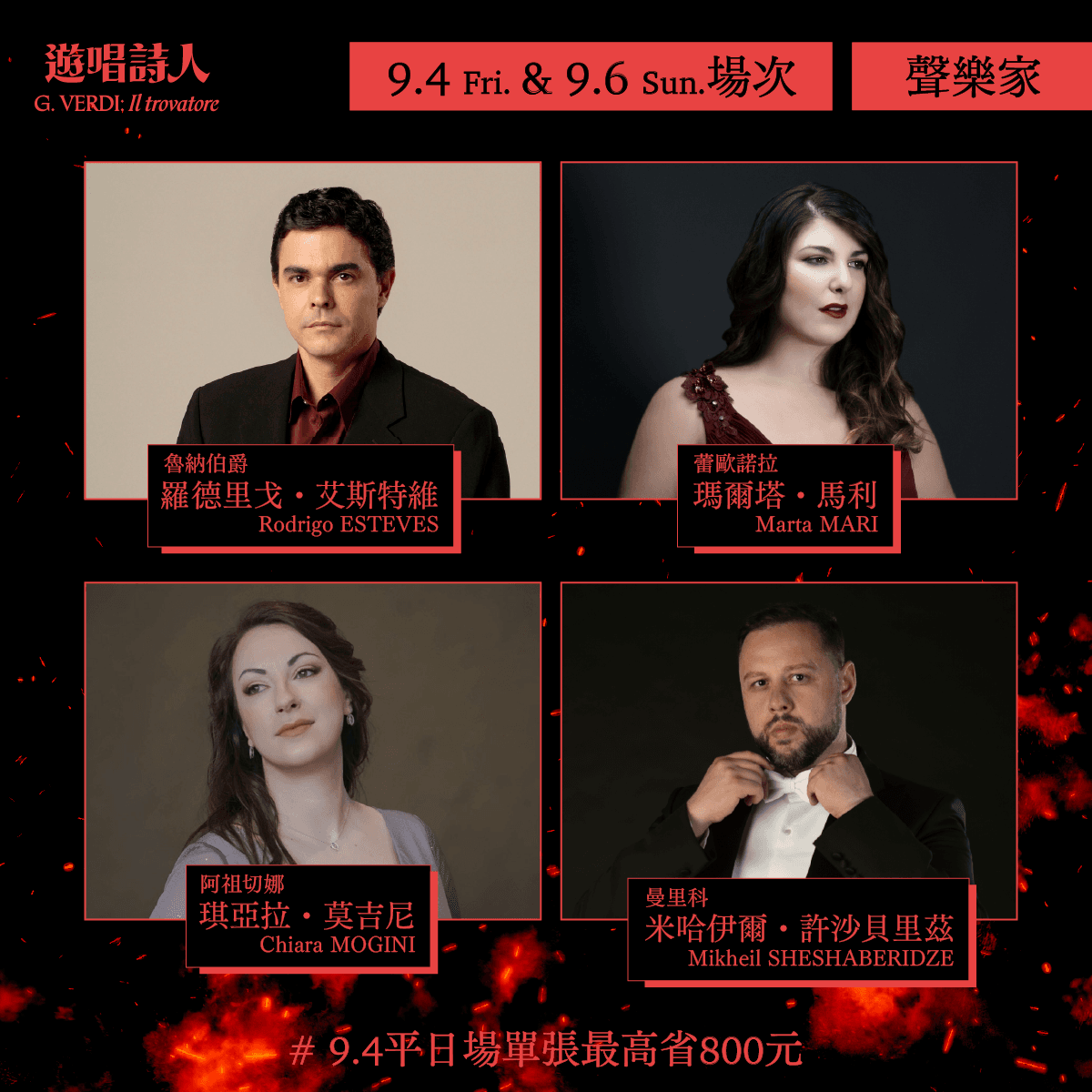
魯納伯爵|丁一憲(9/3、9/5場次)、羅德里戈.艾斯特維(9/4、9/6場次)
蕾歐諾拉|耿立(9/3、9/5場次)、瑪爾塔.馬利(9/4、9/6場次)
阿祖切娜|翁若珮(9/3、9/5場次)、琪亞拉.莫吉尼(9/4、9/6場次)
曼里科|喬治.歐尼亞尼(9/3、9/5場次)、米哈伊爾.許沙貝里茲(9/4、9/6場次)
費蘭多|謝銘謀
伊妮絲|林雯華
魯伊茲、傳令員|張殷齊
樂團|國立臺灣交響樂團
合唱團|微行星聲樂藝術工房
Conductor|CHIEN Wen-pin
Stage Director|Pier Francesco MAESTRINI
Set Designer|Nicolas BONI
Video Designer|Ethan WANG
Costume Designer|Jeffy CHEAH
Lighting Designer|Faye HUANG
Il Conte di Luna|JUNG Ilhun (Sep 3 & 5), Rodrigo ESTEVES (Sep 4 & 6)
Leonora|KENG Li (Sep 3 & 5), Marta MARI (Sep 4 & 6)
Azucena|WENG Jo-pei (Sep 3 & 5), Chiara MOGINI (Sep 4 & 6)
Manrico|George ONIANI (Sep 3 & 5), Mikheil SHESHABERIDZE (Sep 4 & 6)
Ferrando|HSIEH Ming-mou
Ines|LIN Wen-hua
Ruiz / Un messo|CHANG Yin-chi
Orchestra|National Taiwan Symphony Orchestra
Chorus|Planetesimal Vocal Art Studio
📣 周邊活動
2026/8/30(日)14:30 演講廳
►【大師講座】隨歌劇導演走入《遊唱詩人》
2026/9/5(六)17:30
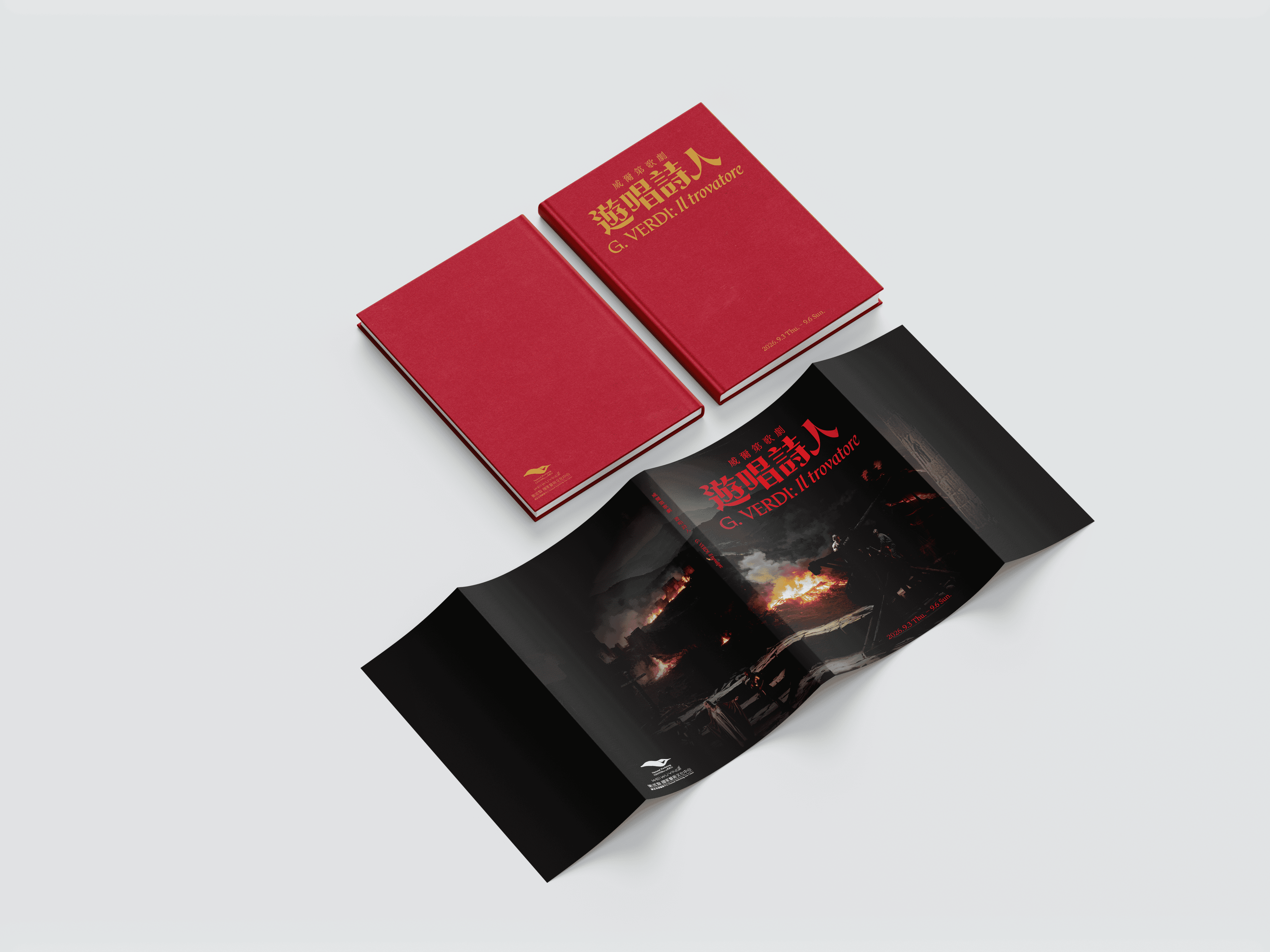
✦ 威爾第歌劇《遊唱詩人》 節目冊 網路限時限量預購優惠 ✦
預購期間:2026年7月20日(一)12:00起至8月20日(四)23:59止
網路預購價:每本NTD 225元(演出現場購買原價:NTD 250元)
購買連結
折扣方案
5/15(五)12:00起 -5/29(五)12:00止,衛武營會員早鳥預購
|衛武營無限卡、生活卡、青年卡、英雄卡會員預購75折。
|衛武營無限卡、生活卡、青年卡、英雄卡會員預購敬老、身障5折。
|無限卡卡友每檔節目限購一張7折。
5/22(五)12:00起 -5/29(五)12:00止,一般觀眾早鳥預購
|一般觀眾早鳥8折。
|敬老票:65歲以上長者購票5折(需憑證入場) 。
|身心障礙人士及其必要陪同者(限1人),享5折(入場時請出示身心障礙手冊)。
5/29(五)12:00起,全面啟售
◆衛武營會員購票優惠
|生活卡9折。
|青年卡本人75折(入場需提供青年卡驗證)。※每場節目限購一次。青年卡加購9折。
|無限卡卡友每檔節目限購一張7折,加購9折。
|英雄卡本人及其親友(限1人)5折。(入場需提供英雄卡驗證,親友需與英雄卡本人同時入場)。
◆信用卡購票優惠
|刷中國信託、台新、富邦、兆豐國際商業銀行、元大商業銀行購票95折。
◆四人同行優惠
|衛武營無限卡、生活卡、青年卡、英雄卡會員單筆訂單購票同場次四人同行75折。
|一般觀眾單筆訂單購票同場次四人同行8折。
◆其他折扣
|兩廳院會員、臺中歌劇院會員、NSO之友9折。
|憑台灣福興員工優惠代碼購票9折。
|高都LEXUS車主優惠碼購票9折。
|誠品會員95折。
|高美館會員購票95折(請輸入代碼)。
|日月光員工優惠95折。
|憑LA ONE會員優惠碼購票享95折。
|敬老票:65歲以上長者購票5折(需憑證入場)。
|身心障礙人士及其必要陪同者(限1人)5折(入場時請出示身心障礙手冊)。
◆團體票
|單筆訂單購票同場次60 張(含)以上 75 折。
◆軍人節專屬折扣
軍人節專屬折扣75折:僅限「中華民國現役軍人」本人使用。(入場時請出示有效之現役軍人身分證)
◆雙館齊唱歌劇套票
8/18 (二) 起,凡購買臺中國家歌劇院《女人皆如此》與衛武營國家藝術文化中心《遊唱詩人》任一場次 1,800元(含) 以上票級,不限張數享8折優惠。
※於OPENTIX網站或APP使用100點(含)以上文化幣折抵票價,即可享有以下優惠:
✔青年席位專屬優惠:每席優惠票價300元,席次有限,售完為止。
✔青年席位五折自由座:享有5折優惠;席次有限,售完為止。
持青年席位票券者,請憑證件入場
退、換票期限:
最遲須在演出日1日前(不含演出日)辦理,逾期無法受理。
例:演出日為6/29,最後退、換票期限為6/28。
【退票】
退票手續費:
每張退票收取票面售價10%手續費。
退票申請方式:
【選擇電子票或尚未取紙本票】
- 以「信用卡、行動支付、文化幣全額支付」購票:
請使用OPENTIX線上退訂功能,至會員>訂單紀錄>點入要退訂的訂單,按下「退訂單」勾選欲退項目,線上完成退訂。
※請留意,每日23:30-00:00為系統結算期間暫停服務。請務必留意退票期限,提前申請。
※購買團票、套票或其他無法使用退訂單功能時,請至網站勾選項目1,填寫訂單資料辦理。申請的退票如符合退票規則,將於3個工作日內執行退票作業。 以「ATM轉帳、現金」購票:
請至網站勾選項目2,填寫訂單資料並附上存摺照片辦理,申請的退票如符合退票規則,將於3個工作日內執行退票作業。
※ATM轉帳繳費時產生的轉帳手續費由銀行收取,如有退票情形(含換、補票及節目異動之退票),轉帳手續費恕無法一併退還。
【已取紙本票】
請由下述退票方案擇一辦理:
- 臨櫃退票:
請於服務時間內,至OPENTIX臺北、臺中、臺南、高雄四大服務處辦理。 - 郵寄退票:
請將存摺影本(刷卡購票無須提供)、票券、姓名電話等聯絡資訊於退票期限前(郵戳為憑),掛號郵寄至「100012臺北市中正區中山南路21-1號 OPENTIX 退票小組收」。退票郵寄前請記下票面之訂單編號,並請妥善保存掛號收據。
※郵寄退票之退票手續費發票將預設存入OPENTIX會員載具,如有其他需求,請郵寄後致電客服中心(02)3393-9888。
※以ATM轉帳或現金付款之票券,將在收到郵寄退票申請後,最遲10個工作日內轉帳至所提供之存摺帳戶;以刷卡付款之票券,退票款項將退還至原刷信用卡。
【換票】
換票手續費:
同時符合以下條件時,可適用每張20元之換票手續費優待。
- 節目之主辦單位為「國家表演藝術中心國家兩廳院」、「國家表演藝術中心臺中國家歌劇院」、「國家表演藝術中心衛武營國家藝術文化中心」、「國家表演藝術中心國家交響樂團」。不包含合辦節目。
- 限「同一檔節目」(即同一節目頁面),其中的場次/票價/方案/座位皆可換票。套票不適用換票。
換票申請方式:
至OPENTIX臺北、臺中、臺南、高雄四大服務處臨櫃一退一買,或請聯繫 OPENTIX 客服中心02-3393-9888 洽詢。
注意事項:
如購票時使用文化幣或點數折抵,退票時,系統將退還折抵之全額文化幣,並於扣除退票手續費後,優先退還點數,再將剩餘款項退回。特別提醒,退票時(含換、補票及因節目異動之退票),原訂單所抵用的點數、文化幣、優惠券已逾使用效期,恕無法補發或展延效期。(如優惠券發放之主辦單位另有規劃者,依該主辦單位規範辦理)
- 【優惠組合退票】若購買兩個品項以上之優惠組合,退票須全數辦理退票,或退票後剩餘數量仍符合原優惠組合規則,方可辦理。
【套票退票】套票退票需整套辦理,無法以單張票券申請退票,亦不接受換票。如購買不同場次票券,最遲需於所購買的首場演出日1日前(不含演出日)辦理,如套票另有規定者,請依套票頁面之注意事項為主。
※ 依據文化部「藝文表演票券定型化契約應記載及不得記載事項」第3點規定,若本節目因故取消、延期舉行之主要表演人員或主要節目內容,於預定表演前發生變動時,相關退票機制、受理方式、退款途徑等資訊,將另行公告於本節目頁面;若遇上述異動情境,主辦單位未提供退款機制時,以信用卡購票之持卡人,可向原信用卡發卡行申請信用卡爭議款退款。